Zoran N. Đorđević, in his first cycle City (1988), established himself both as a draftsman and as a painter. In his drawings, by scraping through layers of densely applied ink, he revealed the whiteness of the paper, allowing light to shimmer and space to come alive. He found his starting point in urban motifs, and his outcome in the rhythms of surfaces, in the subtlety or expressiveness of lines, in the occasional more precisely defined geometric form or sign, in the relationships between black and white—sometimes enhanced by the presence of a gray surface. In certain paintings from the same cycle, through black and its gradations, as well as through free brushstrokes, he achieved a dramatic atmosphere; in others, by applying pigments from a carefully selected palette and then partially removing them, he skillfully drew tones out from depth and created delicate, minor tonal harmonies. With geometric forms—most often rectangles—he suggested the outlines of buildings, yet his primary aim lay in visual effects and painterly values. Through an economy of iconography, he directed attention to the beauty of the plastic structure and foreshadowed the direction of his future artistic pursuits.
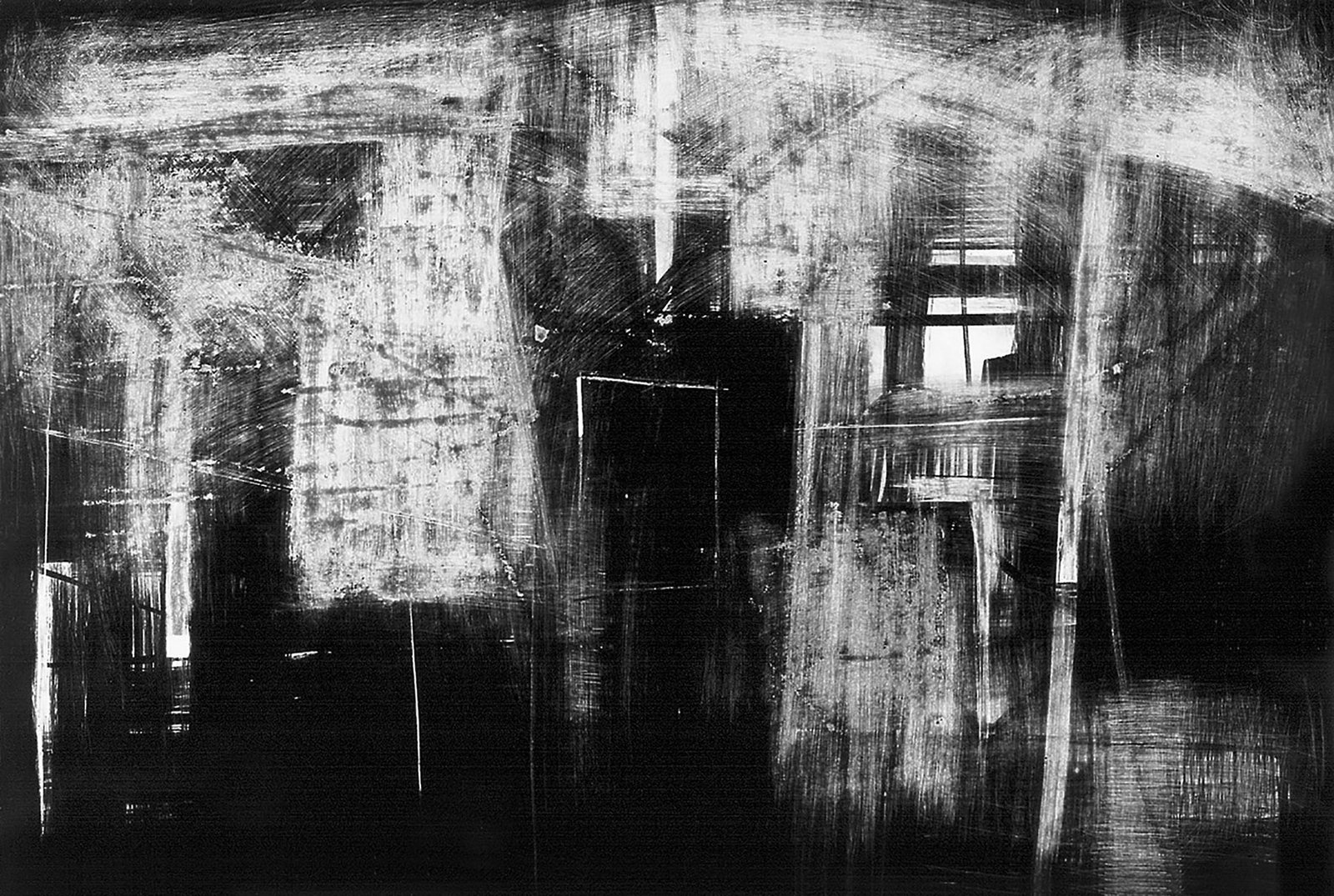
City No 3, 1988.
It seems that the uncertainty of creating aesthetic expanses is already suggested by the title of the new cycle of paintings and ink drawings, Terra Incognita (1989). Zoran continued to apply the same drawing procedure, yet through associative landscapes he increasingly moved toward abstraction. With gestural sweeps, he established dynamic linear networks from which light radiates, testifying to an Orthodox spirit as the common denominator of his oeuvre. However, the paintings from the same cycle are characterized by a different structure. They are woven from subtle relationships of geometric surfaces of varying sizes and from a highly reduced yet wondrous chromatic register, whose grounding could easily be found in the subdued resonance of Byzantine frescoes.
He titled the series of paintings created that same year Terra Magica (1989), seemingly in order to establish a connection with his previous work. The first in the series chromatically merges with the last from the preceding cycle. The others are based on the same, somewhat lighter palette, set against vibrant, monolithic fields of red, yellow, white… Perhaps, even in the title of the cycle, Zoran alluded to Paul Klee’s Magic Squares, through which Klee “used geometry not only for purely painterly achievements but also to express organic life and a certain complex reality. He employed forms that appear abstract—and indeed are—such as squares, rectangles, triangles, yet he was able to present these compositions as figurative works…” The great Swiss artist, “with one foot in the figurative and the other in the abstract, on the demarcation line between these realms, continually encourages our spirit to cross the boundary in both directions.” Unlike him, Zoran is exclusively devoted to abstract expression, although he often starts from real, tangible objects—but never from the human figure.
A turning point in the further development and interweaving of the previous cycle, Terra Orthodoxa (from 1990), is marked by Church (1989–1990), a painting created as an unforgettable memory of his stay in Studenica. It seems that within the form of the dome the entire temple is contained; in its incisions, the flow of time; in its austere texture and chromatic harmonies, an admiration for Serbian medieval fresco painting; and in its extreme reduction, the realization of Pavel Evdokimov’s insight: “…that we are in the presence of Beauty not when there is nothing left to add, but when there is nothing left to take away…” It is quite certain that Zoran belongs to artists of a minimalist orientation—that through an extremely ascetic approach to all visual elements, he succeeds in offering a richness of expression.
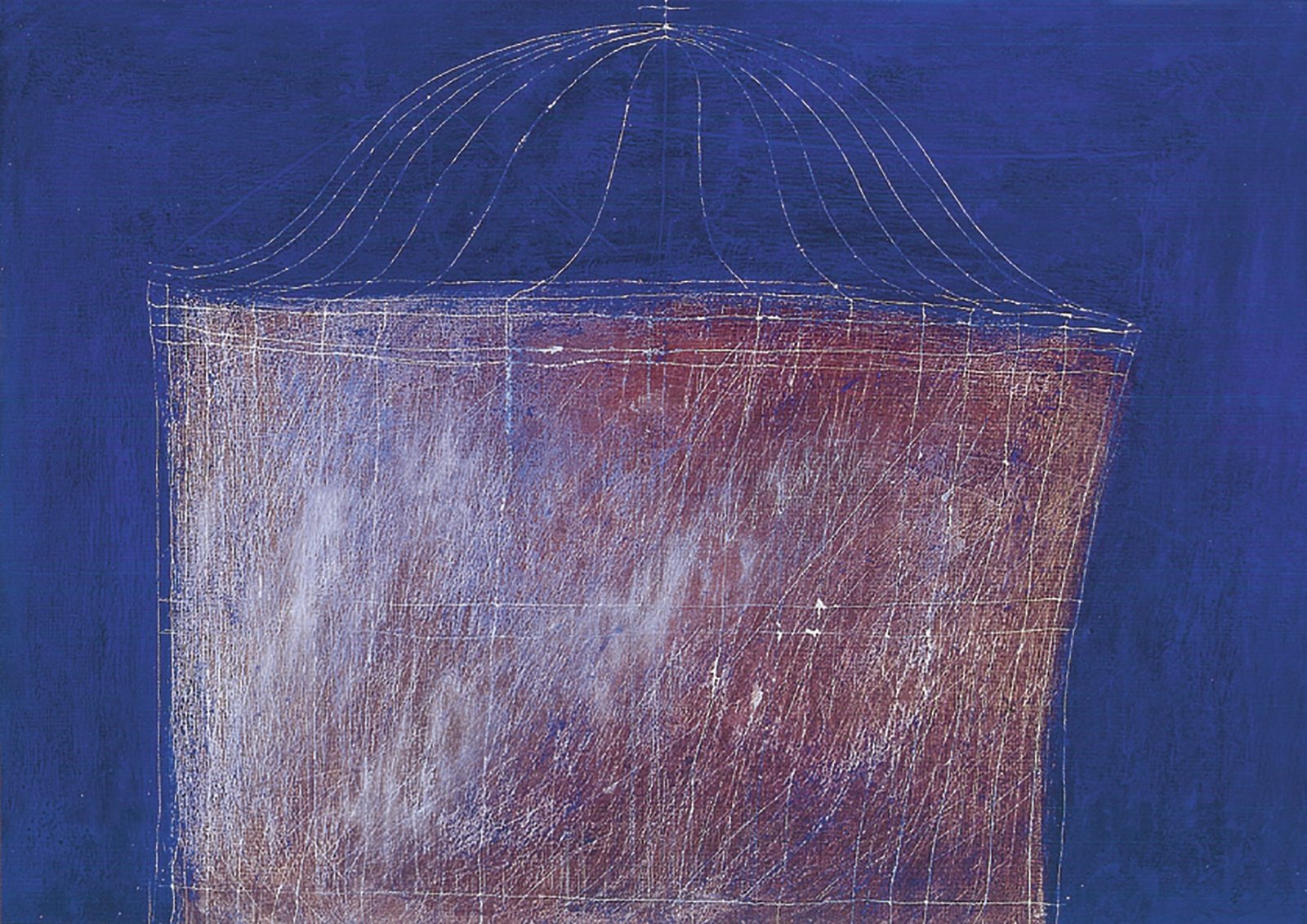
Church No 3, 1989/90.
The works from the cycle Terra Orthodoxa also demonstrate that Zoran skillfully employs both line and surface. His drawing varies in approach: it is achieved through scraping, through deftly guided pen work, or merely suggested. The first is more expressive and gestural, primarily serving to release light and emotion; the second, more deliberate and precise, unfolds like a sharp sound that suddenly emerges—like a discharge of energy across seemingly small planes—directing attention toward signs and meanings; the third is only hinted at, like a gentle touch along slightly diffused edges of subtle, colored, always more or less striated geometric fields, which at first alluded to the city and later transformed into pure forms.
Inclined toward experimentation and reflection, Zoran naturally arrived at the cycle Traces of the Subconscious (from 1993). He began it with minimalist constructions consisting of canvases stretched over a blind frame, at whose centers are affixed drawings executed using computer techniques. He realized that the same surface, without any manual intervention, could be animated by the constantly shifting shadow cast by a materialized line—a curved umbrella wire—which continuously glides across the surface, producing an ever-changing trajectory. In this work as well, light is essential for the proper perception and understanding of the artist’s fundamental intentions.
Two years later, Zoran continued the same cycle with paintings on wood, where the material itself—through its visual qualities and layers of time—participates in the compositional structure. He also established a connection with the ground through ornament, which “carries the entire artistic expression; it is practically unstoppable and chronologically indeterminate—from the decoration of prehistoric pottery to the recently worn peasant belt, woven bands, and carvings.” Todor Stevanović, with good reason, emphasized that Zoran’s cycle Terra Orthodoxa points toward an Orthodox homeland “from the standpoint of both nature and art. Nature is the land of Serbia—art is the Serbian Byzantium,” and noted that “the artist and the art belong to the same homeland.” This painter and draftsman of similar orientation, also a writer and philosopher, and a keen connoisseur of Zoran’s oeuvre, convincingly demonstrated that “Trace of the Subconscious is nothing other than free consciousness, and free consciousness is nothing other than the manifesting power of art.”
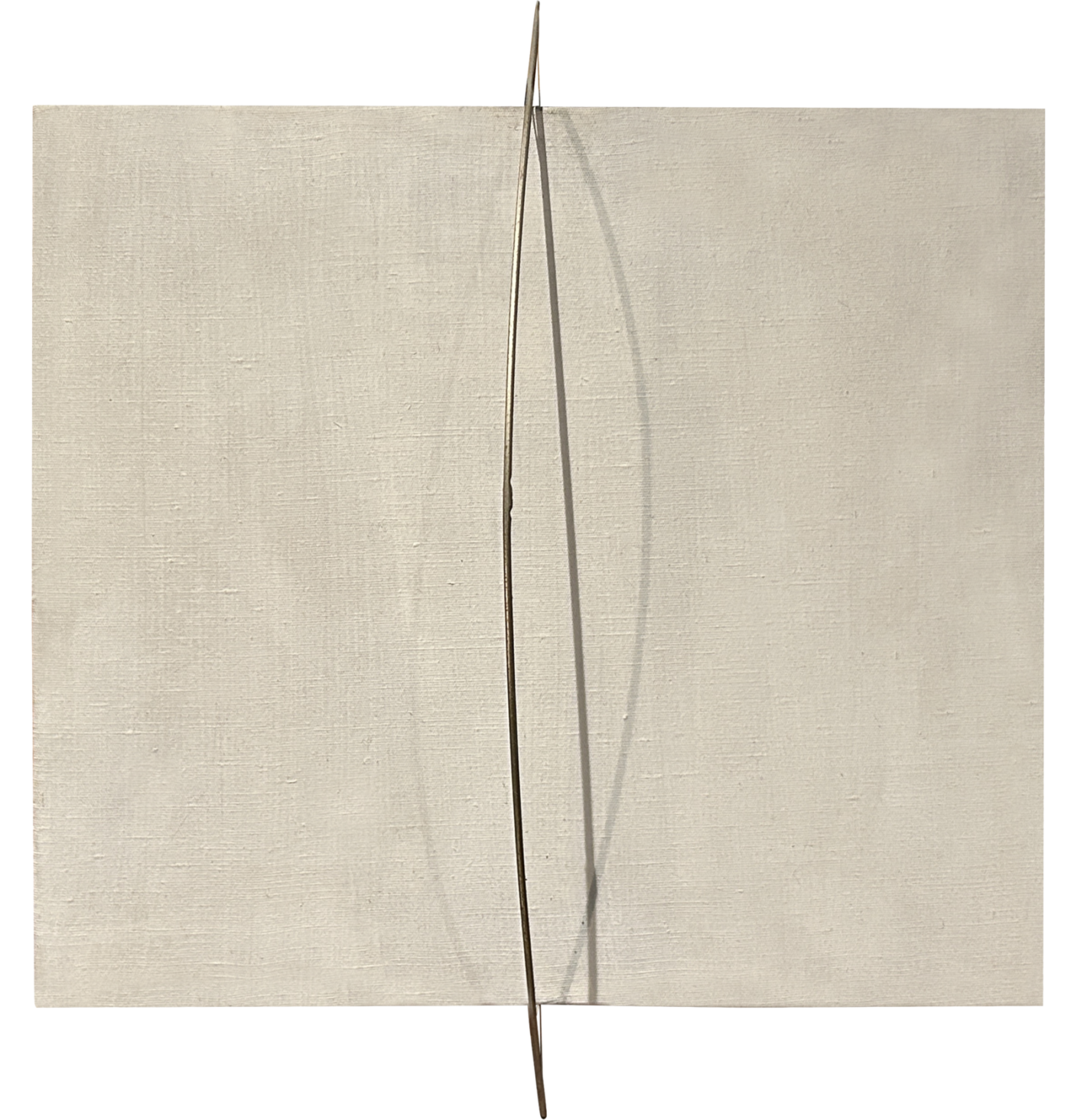
Kinetic drawing, 1993.
The fact that Zoran used the technique of egg tempera for the works from the cycle Traces of the Subconscious (from 1995) also points to his search for sources in Orthodox icon painting. However, he did not approach the icon through the repetition of archetypal models by meticulously rendering the customary figures and scenes upon which Christianity is founded, but rather through a search for meaning—by translating the immaterial into painterly matter and revealing transcendence. Increasingly, he turned toward a “world without objects,” in order to transform non-objective painting into tangible objects—paintings-objects, a universe unto itself.
White, black and ultramarine, brown, dynamic and static rhythms, light… Into layers of black, Zoran incises playful geometric arabesques so that light may radiate from the whiteness of the ground; dense, opaque applications of white in varying tonal values are animated by the action of small, irregular fields created by removing pigment with the tip of a chisel. He articulated thought through spiritualized matter; the grain, cracks, damages, and noble tones of the wood he skillfully preserved so that, in conjunction with his ascetic solutions, they offer an extraordinary aesthetic experience.
The essence of the works from the cycle Traces of the Subconscious, created between 1995 and 1997, also lies in real space. Zoran established, in an exceptional manner, relationships between the quiet resonance of painting-objects and the silence of the space he occupied—not only with the painting-object but also with a polychromed beam-sculpture that hangs and constantly eludes a pedestal of lost purpose, so that, alongside pictoriality and form, it operates through movement and the anticipation of a return to balance.
His exhibition at the Cultural Center of Belgrade functioned as a distinctive sacred whole, belonging to the heights of global minimalism, which at the time was prominently represented at the Venice Biennale. It is important to note that in certain works he built upon the refined chromatic sensibility of Aleksandar Tomašević, who, among the first, transposed the details and atmosphere of Serbian medieval fresco painting into a fully contemporary visual expression. For this reason, we consider that this artist—who successfully united tradition with the demands of the present, elevating the local to universal and timeless heights—should be regarded as Zoran’s spiritual and poetic kindred.
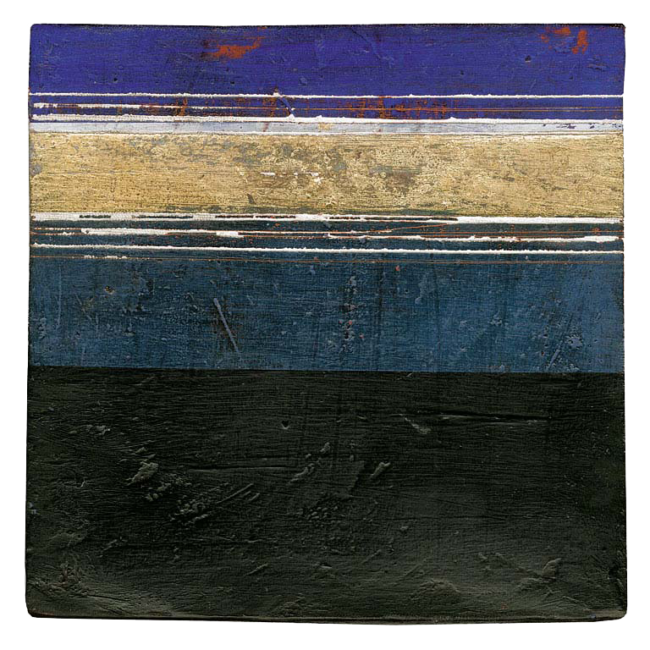
Traces of the subconscious No 4/99
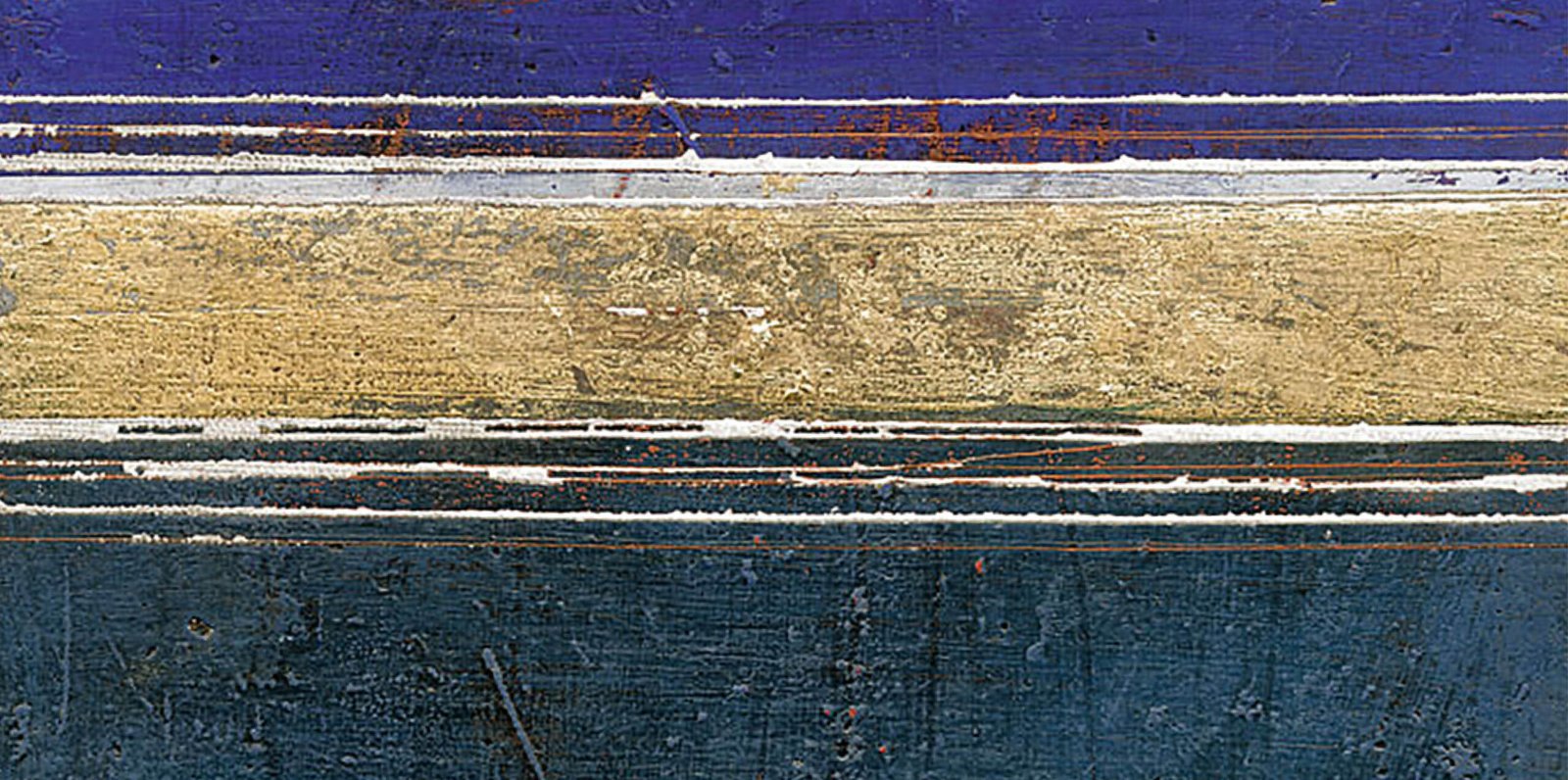
Continuing the cycle Traces of the Subconscious (after 1997), he introduced into his distinctive icons the “light of immaterial gold,” which, as Dejan Đorić writes, “dwells in the time of ancient frescoes and icons.” In Orthodoxy, gold signifies light—above all, spiritual illumination and incorruptibility—which Zoran understands well and employs with increasing mastery. He intensified the strength of chromatic contrasts and emphasized them with narrow or broader golden surfaces, affirming an “aesthetic experience that calls for the interaction of opposing colors.” He never aspired to Op Art effects. Through predominantly horizontal bands of varying chromatic composition, he achieved simple yet exalted accords, at times close to the unison sound of Orthodox chant.
In a time marked by the decline of the harsh twentieth-century civilization—by the renunciation of painting and the aesthetics of the ugly promoted by the financially most powerful, which spilled into our lives—Zoran offered devotion, thoughtfulness, spirit, soul, beauty… It could be said that he increasingly freed his works from all possible associations and themes, allowing them to become self-sufficient, “complete, whole, and fulfilled within themselves.” In this way, he boldly continued his movement toward the attainment of absolute values. Drawing from the sources of tradition, he succeeded in mastering his influences, adapting them to himself and to the demands of the time. Through an authentic creative practice aimed at finding order in chaos, meaning in meaninglessness, light in the darkness of humanity’s downfall, he enriched the currents of geometric abstraction and minimalism as significant movements within world art.
Ljubica Buba Miljković
(Zoran N. Đorđević, drawings, paintings, objects,
Art Gallery
“Nadežda Petrović” – Čačak,
City Gallery – Užice,
National Museum – Kruševac 2001.)